
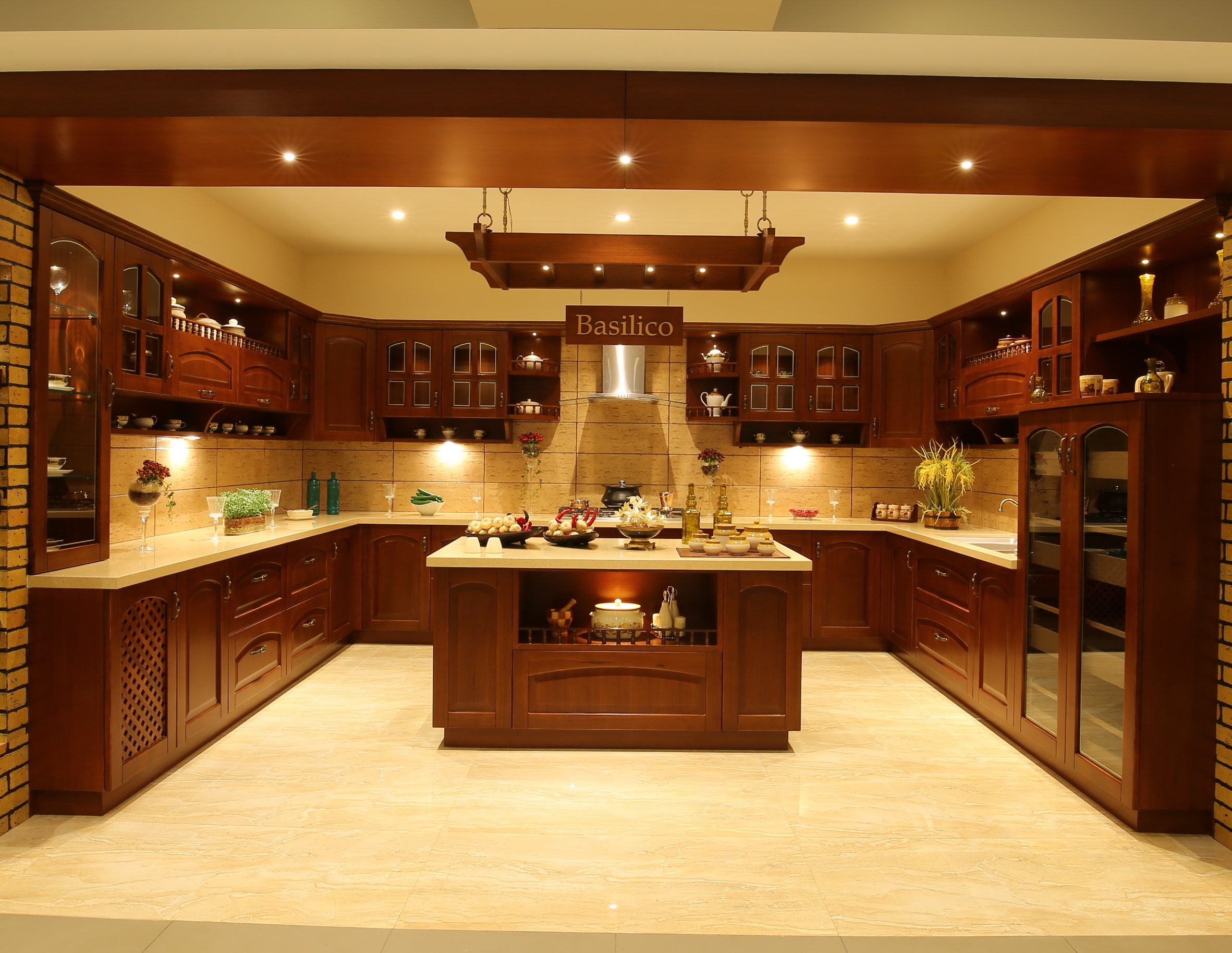
While designing a luxurious home, every room matters. However, the kitchen has a special place in everyone’s mind, as many of us spend maximum time in the kitchen. Hence, everybody needs an exclusive, modern, stylish, and functional kitchen with an appropriately planned layout. A proper layout can help save 20-25 percent of the user’s time. […]
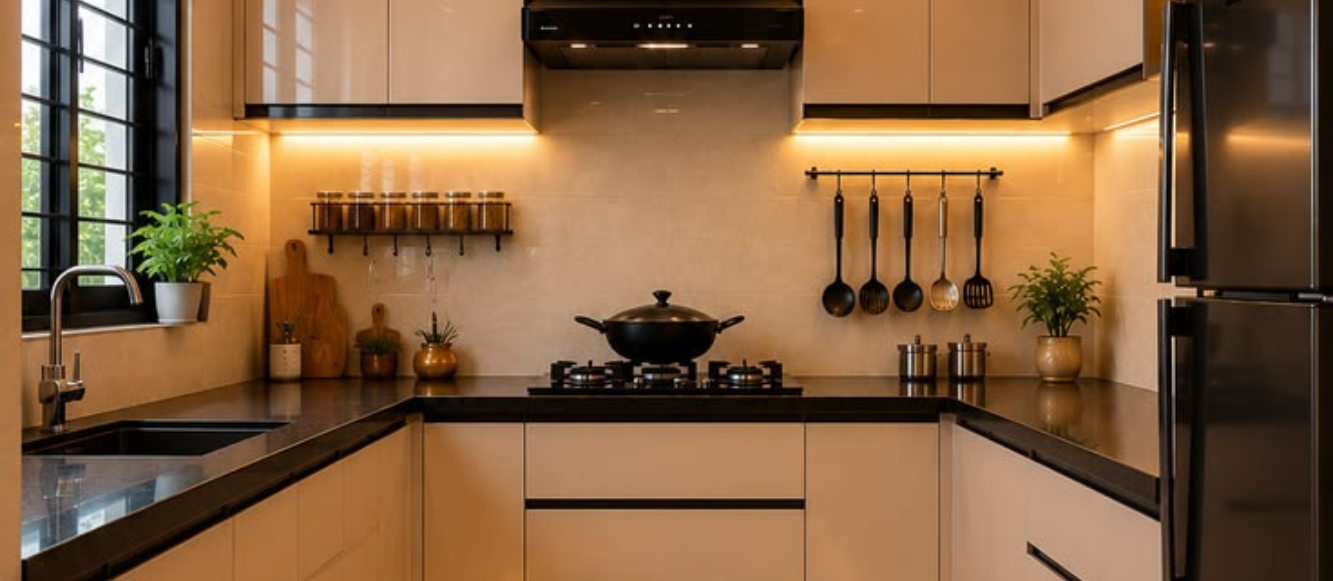
Modular Kitchen in Pune: Climate-Smart Layouts and Storage That Works
Introduction
Pune kitchens face a challenge that many homeowners underestimate. The monsoon season delivers high humidity for three to four months every year. This moisture penetrates cheap cabinet materials over time, causing swelling, warping, and mould growth. Most modular kitchen failures in Pune are caused by humidity — not poor craftsmanship. Choosing the right materials and storage systems from day one protects your investment for a decade or more.
Approximate Cost Ranges for Pune Kitchens
Pune has its own pricing dynamics shaped by local labour costs, material availability, and apartment typologies. Costs vary meaningfully depending on layout, substrate grade, and finish tier.
Compact straight kitchens in 1-BHK apartments across Kothrud, Wakad, and Baner are typically the most affordable starting point. They provide a clean, functional setup without excess spend.
L-shaped kitchens are the most popular layout in Pune’s 2-BHK and 3-BHK apartments. The layout fits naturally into most floor plans and sits in the moderate-to-mid-range cost bracket. Final cost varies based on material tier and depth of cabinetry.
U-shaped kitchens start at a noticeably higher budget. They deliver maximum cabinet storage and suit families who cook daily with heavy ingredient volumes.
Luxury villa kitchens in areas like Koregaon Park, Kalyani Nagar, and Baner Highlands are a different category entirely. Custom islands, walk-in pantries, and dedicated utility rooms push budgets significantly higher. These projects should be scoped individually based on specific space and finish requirements.
Why Pune’s Monsoon Changes Your Material Decisions
This is the most important decision a Pune homeowner makes when planning a modular kitchen. High monsoon humidity over multiple seasons causes standard MDF and particle board to absorb moisture. Once swelling begins, it cannot be reversed — the cabinet must be replaced.
BWP IS:710 marine-grade plywood is the recommended carcass material for all wet zones in Pune kitchens. It is boiling-water-proof and anti-termite. Specify it for every base cabinet, sink housing, and any unit adjacent to the dishwasher or hob.
HDHMR (High-Density High-Moisture-Resistant) board is a cost-effective complement to BWP plywood. It performs well in semi-dry and upper cabinet zones. HomeLane’s HydroGuard Plus boards fall into this category and are a practical choice for overhead and loft units.
Countertops must always be non-porous in a Pune kitchen. Quartz and granite both resist moisture absorption effectively. Wooden countertops or porous composite surfaces should be avoided in high-humidity environments.
Smart Storage Solutions for Compact Pune Apartments
Most Pune homes are 2-BHK or 3-BHK apartments with tight kitchen footprints. Smart storage systems significantly increase usable storage capacity without expanding the kitchen boundary. Here is what to consider.
Corner Units — Recovering Wasted Space
Standard corner shelves are difficult to reach. Items pile up at the back, unused. Two specialised mechanisms fix this problem effectively.
A LeMans pull-out uses a swing-arm mechanism to rotate deep corner items forward. You never need to reach into the corner — the storage comes to you. A rotating carousel tray achieves a similar result with a spin-out motion. Both convert the most wasteful zone in any kitchen into fully accessible storage. These mechanisms carry a moderate-to-significant cost premium over standard corner shelving, but the functional return is substantial.
Tall Pantry Units — Maximum Storage in Minimum Floor Space
A tall pantry unit is a slim, vertical cabinet that runs floor-to-ceiling. Internal pull-out racks and adjustable shelves store dry groceries, flours, oils, and spice bottles in a single organised column. The main countertop stays completely clear. This is one of the most effective storage upgrades available for compact Pune apartments.
Bottle Pull-Outs — An Organised Cooking Zone
Bottle pull-outs are narrow, multi-tier drawers placed directly beside the hob. Oils, ghee, sauces, and frequently used bottles stay upright, organised, and within arm’s reach during cooking. Nothing tips over or gets buried behind other items.
Under-Sink Units
Under-sink pull-out bins and dedicated shelf inserts keep cleaning supplies contained and organised. They protect adjacent cabinet walls from moisture splash — a particularly important consideration in Pune’s humid climate.
Cutlery Organisers
Custom drawer inserts fitted into shallow drawers give every utensil, spice jar, and small cooking tool its own slot. Nothing shifts during use. Prep becomes faster and less frustrating.
Where to See These Solutions in Person in Pune
Visiting a showroom before finalising your kitchen design is strongly recommended. Seeing materials side-by-side and physically testing pull-out mechanisms builds confidence before you commit.
The IVAS Modular Kitchen Center on the Solapur-Pune Highway in Hadapsar demonstrates climate-appropriate materials, soft-close hardware, and full layout configurations suited to Pune apartment typologies.
Kitchen Mine in Kalyani Nagar specialises in custom kitchen services. Their team understands the spatial constraints common to Pune’s mid-rise residential buildings. A visit allows you to compare substrate samples and test mechanism quality before placing an order.
Build It Right the First Time
Pune’s climate does not forgive material shortcuts. Specifying BWP marine plywood for wet zones and non-porous countertops costs modestly more upfront. It protects your kitchen from moisture failure for 15 years or longer. Combine that material foundation with the right storage systems and a compact Pune kitchen can perform as well as one twice its size.
Discover a smart modular kitchen in Pune designed for local weather conditions, monsoon protection, and modern lifestyles. Choose durable materials like BWP plywood with space-saving storage solutions for compact apartments. Get expert guidance and stylish kitchen designs tailored to your home needs. Create your dream kitchen with Kitchen décor.
20 Frequently Asked Questions
Q1. What makes modular kitchen planning in Pune different from other cities?
A: Pune’s monsoon season delivers high humidity for several months each year. This makes substrate material selection far more critical than in drier climates. MDF and particle board absorb moisture and fail. BWP marine plywood and HDHMR board are the appropriate choices for Pune kitchens.
Q2. Which carcass material is best for Pune’s monsoon climate?
A: BWP IS:710 marine-grade plywood is the safest carcass choice for all wet zones in Pune kitchens. It is boiling-water-proof and anti-termite. For dry upper zones, HDHMR board is a cost-effective complement.
Q3. What is HDHMR board and is it suitable for Pune?
A: HDHMR (High-Density High-Moisture-Resistant) board offers improved moisture resistance over standard MDF. It performs well in semi-dry zones and overhead cabinets in Pune. It should not replace BWP plywood near sinks, hobs, or dishwashers.
Q4. Which kitchen layout is most popular in Pune apartments?
A: The L-shaped kitchen is the most popular layout in Pune’s 2-BHK and 3-BHK apartments. It fits naturally into most floor plans, balances storage with movement, and accommodates the daily cooking habits of Indian families.
Q5. What is a LeMans corner pull-out and why is it recommended?
A: A LeMans pull-out uses a swing-arm mechanism to bring deep corner items forward without requiring the user to reach in. It converts the most wasteful kitchen zone into fully accessible storage and is particularly valuable in compact Pune apartment kitchens.
Q6. Is granite or quartz better for a Pune kitchen countertop?
A: Both are suitable non-porous options for Pune’s humid climate. Quartz is fully engineered, uniform, and requires no sealing. Granite is natural, varies in pattern, and requires periodic sealing. Both significantly outperform porous composite surfaces in monsoon conditions.
Q7. What are the most useful storage solutions for compact Pune kitchens?
A: The five most effective solutions are LeMans or carousel corner pull-outs, tall pantry units, bottle pull-outs beside the hob, under-sink bins with pull-out organiser inserts, and custom cutlery drawer inserts. These five systems together dramatically increase usable storage without expanding the footprint.
Q8. What is a tall pantry unit and how does it help in a Pune apartment?
A: A tall pantry unit is a slim floor-to-ceiling cabinet with internal pull-out racks. It stores dry groceries, flours, spices, and oils in a single vertical column. It keeps countertops clear and is one of the most impactful storage upgrades in a compact kitchen.
Q9. Can I use MDF for my Pune kitchen cabinets?
A: Standard MDF is not recommended for wet zones in Pune kitchens. It absorbs moisture and swells irreversibly over multiple monsoon seasons. Use MDF or HDHMR only for dry upper loft sections. Specify BWP marine plywood for all base cabinets and wet-zone units.
Q10. What kitchen showrooms are available in Pune to visit in person?
A: IVAS Modular Kitchen Center on the Solapur-Pune Highway in Hadapsar and Kitchen Mine in Kalyani Nagar are two well-regarded Pune destinations. Both allow you to view materials, compare finish samples, and test hardware quality before finalising your design.
Q11. Does monsoon humidity really damage modular kitchen cabinets?
A: Yes. High humidity penetrates standard MDF and particle board over multiple monsoon seasons, causing swelling, warping, and mould growth. This is one of the most frequently reported causes of early kitchen failure in Pune homes.
Q12. What is HomeLane’s HydroGuard Plus and is it appropriate for Pune?
A: HydroGuard Plus is a moisture-resistant board offered by HomeLane as a cost-effective alternative to traditional BWP plywood. It is appropriate for dry and semi-dry cabinet zones in Pune. It should not be specified as a replacement for BWP marine plywood in wet zones.
Q13. What does a bottle pull-out do in a modular kitchen?
A: A bottle pull-out is a narrow, multi-tier pull-out drawer placed beside the cooking zone. It holds oils, ghee, sauces, and bottles upright in an organised configuration within arm’s reach. It prevents bottles from tipping and makes frequently used cooking items immediately accessible.
Q14. How do I plan a luxury kitchen for a villa in Koregaon Park?
A: Luxury villa kitchens in Pune should be scoped individually. Consider a custom island for prep and socialising, a walk-in pantry for dry storage, BWP marine plywood throughout, quartz or engineered marble countertops, and fully integrated built-in appliances. A site visit and 3D rendering are essential before finalising the design.
Q15. What is the minimum I should budget for a monsoon-safe Pune kitchen?
A: A monsoon-safe kitchen requires BWP marine plywood for wet zones, HDHMR or good-quality plywood for dry zones, and non-porous countertops. These material choices add a modest premium over cheap alternatives. The long-term cost of replacing a failed kitchen is always far higher than the upfront investment in quality materials.
Q16. Are under-sink organiser units worth including in a Pune kitchen?
A: Yes. Under-sink organisers keep cleaning supplies contained, protect cabinet walls from moisture splash, and make the area significantly more usable. In Pune’s humid climate, an organised under-sink zone with pull-out bins also helps prevent moisture accumulation that can damage adjacent cabinetry.
Q17. How long should a properly planned Pune modular kitchen last?
A: A kitchen built with BWP marine plywood in wet zones, HDHMR in dry zones, non-porous countertops, and quality soft-close hardware should comfortably last 15 to 20 years in Pune’s climate. Kitchens built with particle board or standard MDF near wet zones often fail within three to five years.
Q18. What is a rotating carousel corner unit?
A: A rotating carousel is a corner storage mechanism where circular trays spin out on a pivot, bringing items stored in the deep corner of a cabinet to the front opening. It is an alternative to the LeMans swing-out mechanism and achieves a similar result of making corner storage fully accessible.
Q19. Should I visit a showroom before ordering a modular kitchen in Pune?
A: Yes, strongly recommended. Seeing substrate samples side by side, testing pull-out mechanism smoothness, and comparing shutter finish textures in person prevents many post-installation regrets. It also helps align expectations between the homeowner, designer, and manufacturer before production begins.
Q20. What countertop thickness is recommended for an Indian kitchen?
A: A minimum countertop thickness of 20 mm is standard for residential kitchens. For heavy daily cooking use and heavier stone slabs like granite, 25 to 30 mm thickness offers better structural stability and a more premium visual mass at the counter edge.
YOU MAY ALSO LIKE
-

How is Kitchen Decor Better Than Your Local Carpenter?
Read MoreIn India, the concept of modular kitchens is pretty old. They’ve gained popularity due to the numerous aesthetic and functional benefits they offer. However, believe it or not, despite the popularity of modular kitchen decor, many people hire local carpenters to build kitchens for them! It isn’t that local carpenters don’t do a good job. […]
-

Best 6 Open Kitchen Living Room Design Ideas for Modern Homes
Read MoreEver wondered why some homes exude style and give an instant feeling of warmth and connection? We’ll demystify it for you if you haven’t figured it out yet. Chances are, those homes had an open kitchen and living room. Open kitchen living rooms aren’t merely a trend but a game-changing style statement. While adding aesthetic […]
-

Pet-Friendly Kitchen Designs: Smart Tips for Animal Lovers
Read MorePets aren’t just animals but an integral part of families that nurture them. Sometimes, these furry and scaly companions sit under the table for dinner, follow you into the kitchen for a quick snack or even nap next to the dishwasher. At Kitchen décor, we receive many prospects with a significant consideration for pets. They […]


